Artificial Intelligence: Fault Triage, Data Quality and Weekly Manager Summary
Suggestions from field text, findings from nightly scans
The Reper Ops artificial intelligence module suggests category, priority and whether the machine can keep operating from the free text entered when a fault record is opened; the suggestion applies to the form in one click, and no field is saved without user approval. Every night data quality is scanned with deterministic rules; the weekly manager summary turns system-calculated numbers into plain English narrative. All findings are collected in the insights queue; token cost and monthly budget are tracked.
Fault triage
From the free text written by field staff, category, priority and whether the machine can keep operating are suggested; rationale and confidence level are shown. Up to three follow-up questions are generated, and the suggestion applies to the form in one click.
Similar past faults
On the fault detail page, past records on the same machine with similar text are listed with resolution notes. Matching uses text similarity and context; no artificial intelligence is used and there is no extra cost.
Data quality findings
Every night meter rollback, physically impossible meter jumps, faults repeated within 48 hours and repeat faults four or more times in 90 days are scanned. Rules are entirely deterministic; artificial intelligence is not involved.
Weekly manager summary
The week's fault, work order, critical fault and category counts are calculated by the system. Artificial intelligence only turns these numbers into plain English narrative and ranks recommended actions; inventing numbers is prevented.
Insights queue
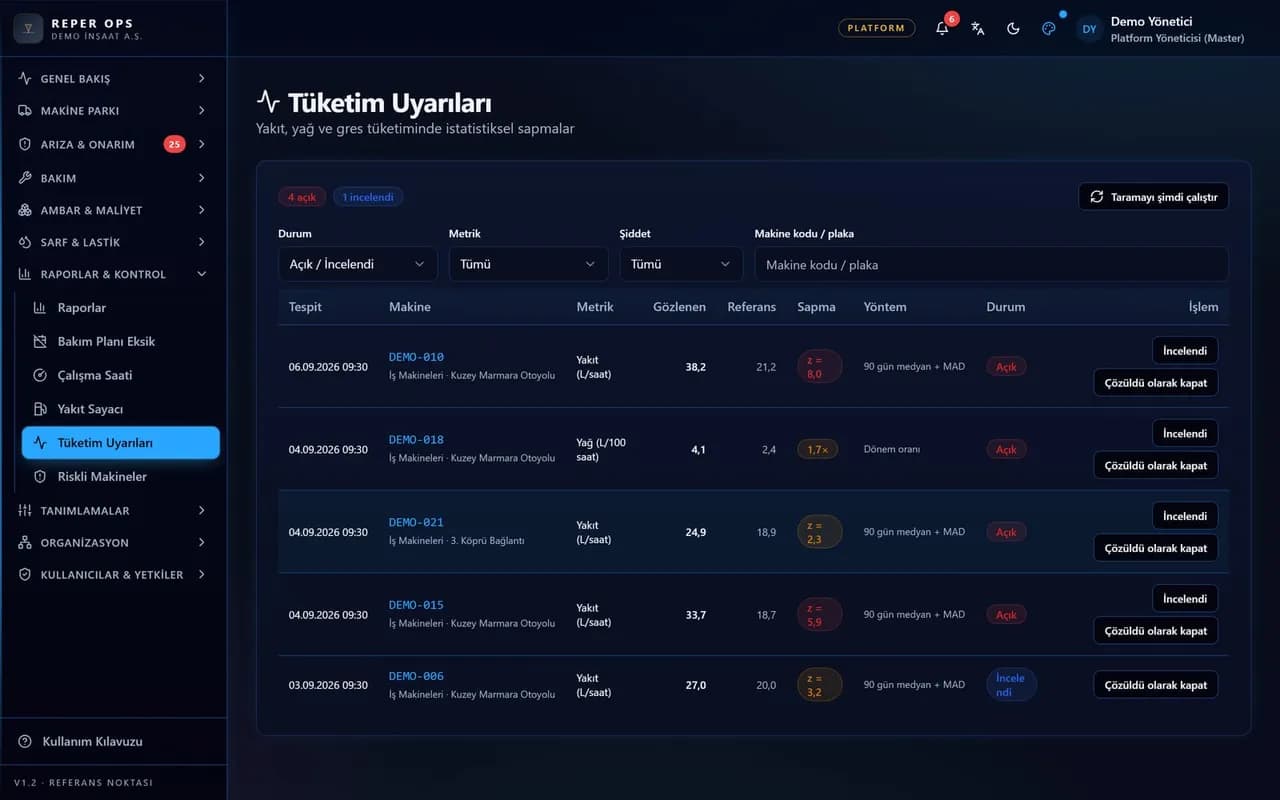
All findings are collected on one screen and filtered by importance, status and type. Each finding is marked as seen or dismissed and receives useful or not useful feedback.
Cost and audit
Every call is logged with tokens and cost; a monthly budget is defined per customer, and when the budget is full artificial intelligence features stop. When the module is disabled, no data leaves the system.
How fault triage works
When a new fault record is opened, the free text written by field staff is sent to the model. The model suggests category, priority and whether the machine can keep operating; each suggestion shows rationale and confidence level. If the text is insufficient, up to three follow-up questions are generated; answers are offered as additional form fields.
The suggestion can be applied to the form in one click; the user can edit the fields or reject it completely. No suggestion is written to the record until approved. The token and cost of the triage call are logged per customer.
Nightly scans and weekly summary
An automatic scan runs every night: meter rollback, meter jumps above 24 hours or 1500 km per day, the same fault entered twice within 48 hours, and four or more repeat faults in the same category on the same machine within 90 days. These rules are entirely deterministic; artificial intelligence is not used.
The weekly manager summary counts opened and closed faults, work orders, open critical faults, active machines and top categories as calculated by the system. Artificial intelligence only turns these numbers into plain English paragraphs and ranks recommended actions; the model cannot invent numbers, only narrate the figures provided.
Human approval, accuracy and feedback
All artificial intelligence output is a suggestion; the user makes the final decision at every step. In fault triage, a suggestion not applied to the form does not enter the record; the weekly summary is for reading only and does not trigger automatic action.
Artificial intelligence can make mistakes; category or priority suggestions should always be verified by a person. In the insights queue findings are marked as seen or dismissed; useful or not useful feedback is collected. A dismissed finding is not produced again.
Cost, privacy and disabling the module
Every artificial intelligence call is logged with tokens and cost. A monthly budget is defined per customer; when the budget is full artificial intelligence features stop and the rest of the application is unaffected. The module can be fully disabled; when it is off no data leaves the system.
Context sent to the model is only that customer's own data; no access is made to another tenant's records. Similar past faults and nightly scans do not use artificial intelligence; token spend is limited to triage and weekly summary calls.
- 1
Data is collected
Fault text, meter records and past faults are posted to the machine.
- 2
Suggestion or scan
Triage suggestion is produced at record time; deterministic data quality rules run at night.
- 3
Human approval
The user reviews the suggestion, applies it to the form or rejects it; findings are marked in the queue.
- 4
Summary and follow-up
The weekly summary is built from counts; cost and budget records are tracked.
FAQ
Does fault triage open a record automatically
No. The suggestion only applies to the form; no field is saved without user approval. Category, priority and operability fields remain under the user's control.
Are similar past faults found with artificial intelligence
No. Matching uses text similarity and category context on the same machine; there is no extra token cost. Resolution notes are read from past records.
What happens when the budget is full
Artificial intelligence features stop automatically; fault recording, work orders and other modules are unaffected. Features resume when the budget is renewed or at the start of the month.