
Why a preventive maintenance plan starts with triggers
A preventive maintenance plan decides in advance which machine gets which service and when. Without one, maintenance happens only after a breakdown or when someone remembers it, which is the most expensive form of maintenance there is. A good plan answers two questions: what triggers the service, and who acts once it fires.
A trigger is the measure that sets the timing. Engine hours are the natural basis on excavators, loaders and dozers, while mileage suits trucks and haulers. Oil changes, filter replacements and greasing each repeat on their own interval, defined at program level rather than machine by machine.
Choosing the trigger: engine hours, mileage or calendar
Engine hours show how much the engine actually ran and are the most accurate measure for wear items such as oil and filters. Mileage fits on road vehicles for tyres, brakes and driveline. Calendar triggers catch what ages with time on machines that sit idle: hoses, batteries, coolant and rubber components.
The most robust approach is the dual trigger: set an hour interval and a calendar interval for the same item, and let the service fall due whenever the first of the two is reached. Busy machines are then caught by hours and parked machines by the calendar.
Balancing manufacturer recommendations with site conditions
The manufacturer manual lists staged intervals of 250, 500, 1000 and 2000 hours, all written for normal conditions. Dusty sites, heavy loads, high temperatures, short duty cycles and poor fuel all call for shorter intervals. An air filter can be finished long before the manual says.
Start with the manufacturer interval, record the condition of the parts you remove during the first few services, then tighten or keep it. Oil analysis tunes intervals on evidence rather than opinion. Keep the decision in the program definition so the plan survives a change of staff.
Steps for building a preventive maintenance plan
Working program by program instead of machine by machine saves a great deal of time. Machines of the same make and model share one program, and the only difference between them is the site based adjustment of intervals. The sequence below is enough for most fleets.
- Split the fleet into groups: earthmoving equipment, trucks, attachments and plant, and set the meter type for each.
- Write maintenance programs by make and model: item name, interval, trigger type and the parts each item needs.
- Take the manufacturer interval as the baseline for every item and note the site correction beside it.
- Assign the program to the relevant machines or the whole group so new arrivals inherit the same rhythm.
- Enter the last service date and meter for each machine, or the first trigger is calculated on the wrong basis.
- Set the warning threshold: how many days or hours ahead of the due point you want to be notified.
- Put in writing who watches the maintenance board and who closes the work order.
Meter data and the warning threshold
A plan is only as good as its meter data. Irregular readings make the hour trigger fire late and the machine works past its interval. Readings come from telemetry, from the operator in the field or from office bulk entry. A separate alert for machines left without a reading closes the gaps.
The warning threshold marks when preparation starts, not when the service happens. If parts take days to arrive it has to fire at least that far ahead. As a rule of thumb, 25 to 50 hours or 7 to 14 days works well, tuned to your lead time and workshop load.
Work order automation: from plan to workshop
A plan does not get maintenance done; the work order does. When a preventive work order opens by itself at the threshold, parts are reserved from the warehouse, the task list fills with check items, and parts and labour are recorded on completion.
Until that loop closes the plan stays on paper. Manually opened work orders get forgotten or raised against the wrong machine. Automation keeps the history unbroken, so overdue, upcoming and planned services appear in one list every morning.
A few indicators show whether the plan works: services completed on time, the number of overdue services, and the balance between planned and breakdown work orders. If breakdown orders fall while planned orders rise, the plan is doing its job. Reading them monthly keeps it alive.
How Reper Axis does this
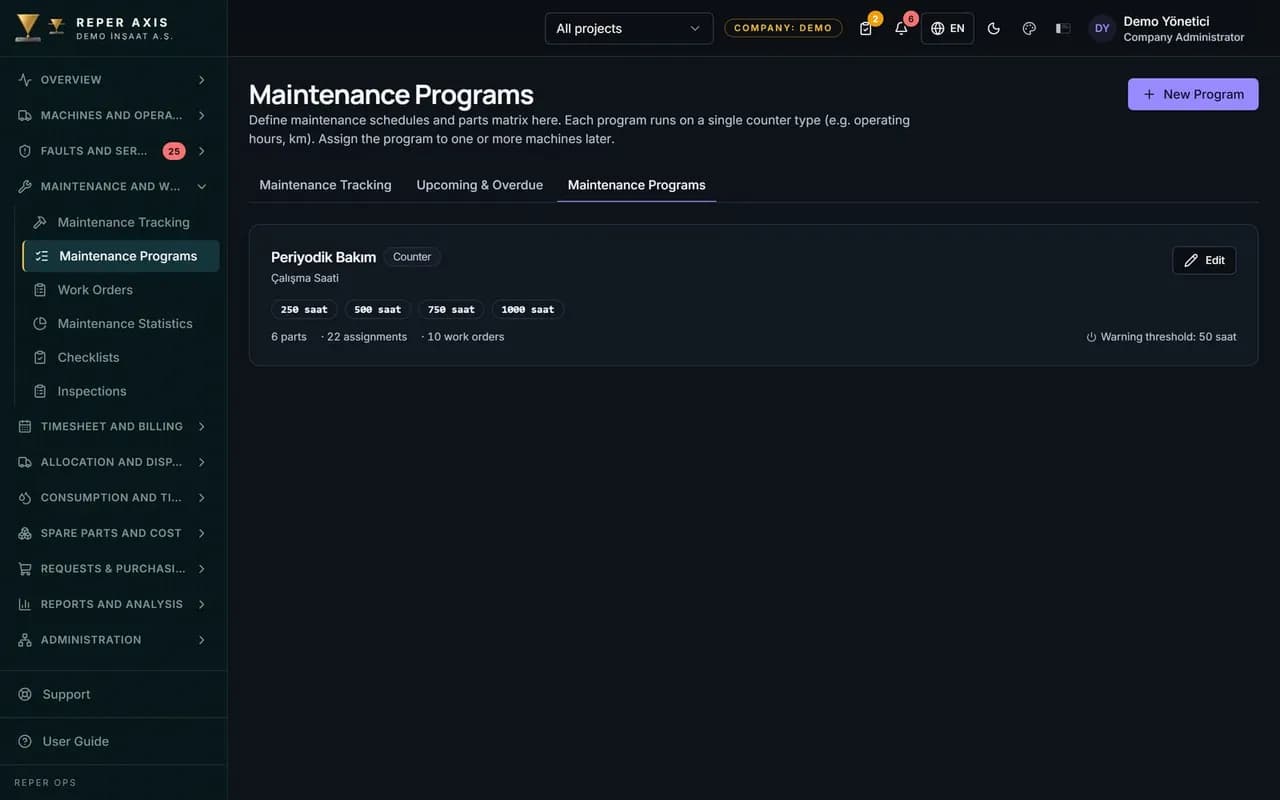
In Reper Axis, maintenance programs are defined by make and model, with the trigger set to meter, calendar or both and the work order created as soon as the first threshold is reached. Program items link to part cards in the warehouse and the warning threshold is set by the company. Meter values arrive from telemetry or by scanning the QR code in the field, and machines left without a reading raise a notification. The maintenance board separates overdue, upcoming and planned items with colour coded badges, and a program applies to a whole group in one action.