
Why spare parts inventory is part of maintenance
Spare parts inventory is usually treated as an accounting task, yet its real impact is felt in the workshop. A machine due for service waits when the filter is missing, a broken machine stands still until the hose arrives, and the same part gets bought twice in two warehouses. Set up properly, the parts are on hand as the work order opens and the cost is posted as it closes.
A sound stock structure answers four questions at any moment: which part sits in which warehouse and in what quantity, which part has dropped below its level, which part fits which machine, and what the consumed parts cost. This guide builds that structure step by step.
Critical parts list and minimum stock levels
Not every part belongs on the shelf. A critical part is one whose absence stops a machine and whose supply takes time: oil, air and fuel filters, hydraulic hoses, belts, batteries, and the pins and bushings that wear quickly. To draw up the list, look at the items consumed most often in the last year of work orders and at the faults that waited longest.
The minimum level is the reorder point. Multiply average monthly consumption by the lead time and add a small safety margin: a filter with a one week lead time and four units a month lands at around two. That figure goes on the part card, and an alert when the level is breached removes manual counting.
Machine compatibility and the part card
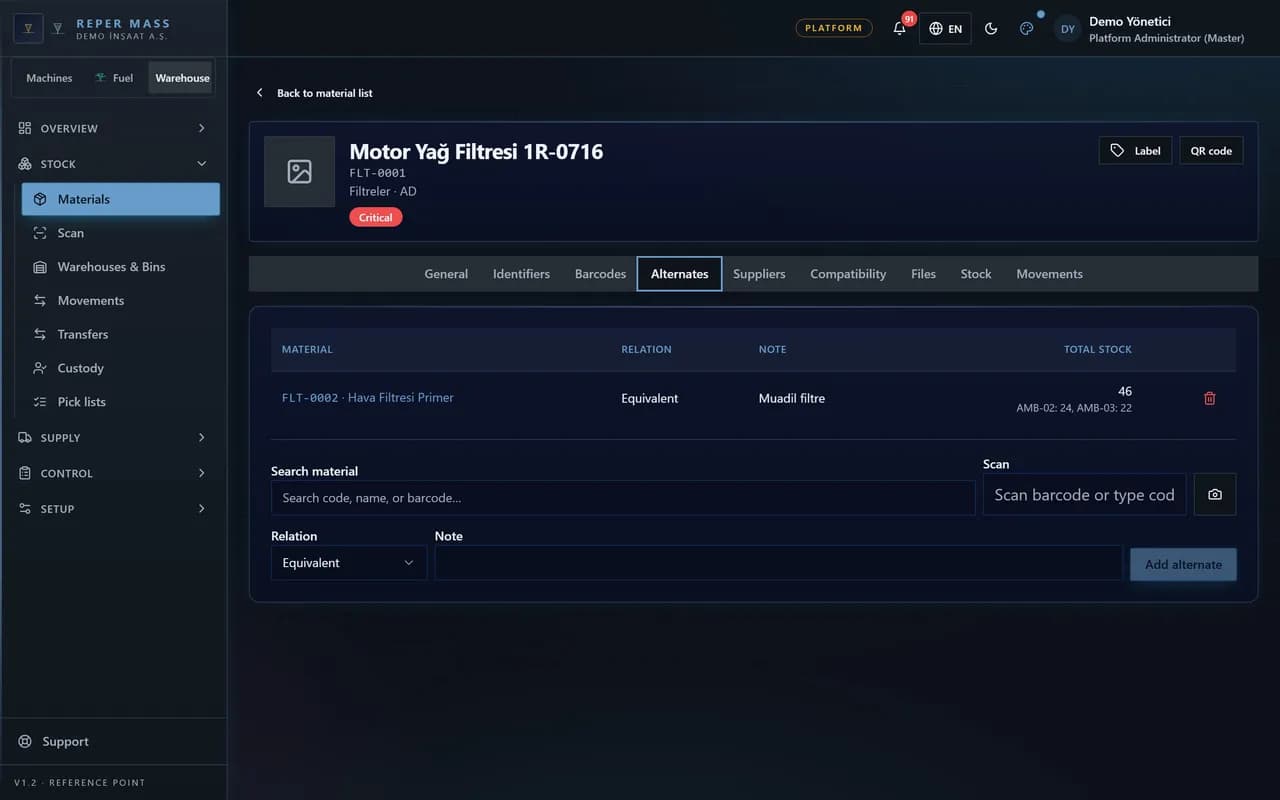
The part card is the identity of the part: code, name, unit, supplier code, minimum level and, above all, which machine types it fits. Without compatibility data the technician adds the wrong filter or goes back to the catalogue. Compatibility is defined by machine group or by make and model, and one filter may fit several models.
Agree the coding scheme up front. Decide whether you build on the supplier code, the original manufacturer code or your own internal code; mixing them leaves the same part sitting under two separate cards. Noting equivalent parts on the card also gives purchasing more flexibility.
Reservation and consumption on the work order
The bridge between stock and maintenance is the work order. When one is planned, the parts are reserved from the warehouse so another job cannot take them and the technician finds them waiting. On completion the reserved parts are consumed, the balance drops and the cost is posted to the machine. No separate issue slip is needed.
Reservation discipline prevents two classic errors: a part assumed available but already gone to another job, and a part used but never recorded, which keeps showing as available. When a maintenance program's parts list flows into the work order, the needs of planned services become visible weeks ahead.
Warehouse movements and stocktaking
The stock balance is the sum of its movements, and four types are enough: receipt, issue, transfer between warehouses and stocktake adjustment. A receipt is a delivery or a serviceable part returning after removal; an issue is consumption on a work order; a transfer moves parts between sites; a stocktake corrects the gap between the physical count and the system.
In a multi site structure each warehouse keeps its own balance while the part card is shared, so a shortage on one site can be covered by surplus on another and a transfer replaces a purchase. Count regularly but in rotating groups rather than the whole warehouse at once, and store who and when for every movement.
Costing and purchase requests
The same part is bought at different prices, so you have to decide how a consumed part is costed. For site warehouses, weighted average cost is the most practical: at each receipt the value on hand and the value received are added and divided by the total quantity to give a new unit cost. Consumption posts at that value.
A purchase request grows out of the minimum level alert and is followed through draft, request, order and delivery. Where the request stands feeds back into the maintenance plan: knowing when an ordered filter arrives lets you set the service date around it. Delivery becomes a stock receipt and the loop closes.
How Reper Mass does this
In Reper Mass part cards carry the machine types they fit, so the technician picks from a list limited to parts that suit that machine. Parts are reserved as the work order opens, deducted on completion and posted to the machine at weighted average cost. Receipts, issues, inter warehouse transfers and stocktakes sit in one module, and multiple warehouses are managed with separate balances. A part below its minimum level notifies the warehouse and purchasing and appears in the alert panel. Purchase requests run through draft, request, order and delivery, and the inventory report exports quantity and stock value to Excel and PDF.