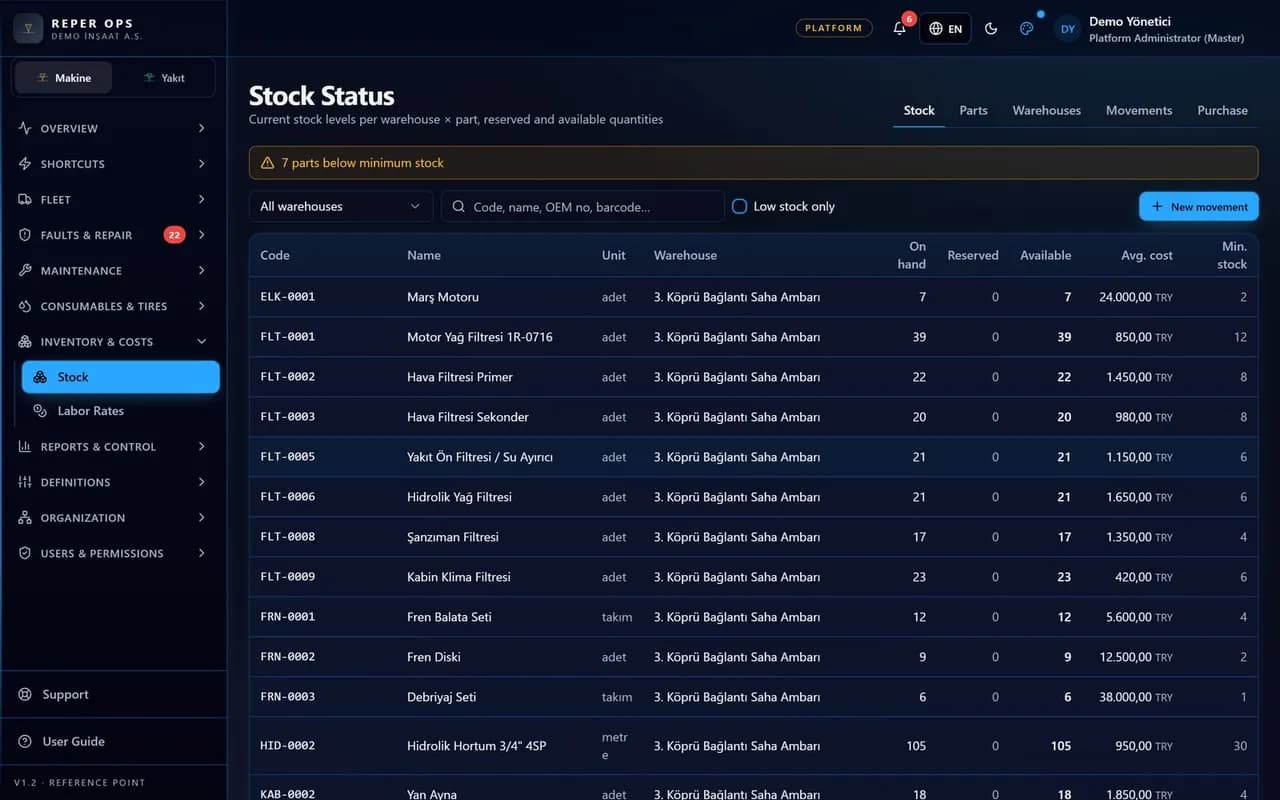
OEM, equivalent and cross-reference
The OEM number is the manufacturer reference tied to warranty and manuals. An equivalent is another make that performs the same function; life may differ. A cross-reference maps supplier catalogue codes for search only — not approval.
When concepts mix, one filter becomes three SKUs, stock splits and work orders pick wrong codes. One primary card should hold the approved main reference; alternates live in a relation table.
Approval and ownership
Equivalent use is an engineering call. Maintenance lead defines which alternates are allowed per machine type and conditions. Unapproved stock must not be selectable without warning. Records need date, reason and scope.
Define emergency approval when supply is tight; verbal OK must be posted later. Mounting without trace risks warranty and repeat failure.
Building the cross table
Price lists and legacy ERP codes feed the table: source code, target master, supplier, validity. Search must route to the master card.
Never auto-merge because two codes look alike. Merge only after stock moves and count prove physical equivalence.
- Machine type fit mandatory on the master card.
- Alternate rows show approver and date.
- Retire old codes with redirect, not delete.
- Supplier change updates price and lead time on its own row.
Stock and reservation
Reservations consume the master first. If rules allow, suggest an approved equivalent when stock is zero — otherwise fitters grab at random.
Average cost differs by alternate; machine cost must show which card was used. spare parts inventory module keeps fit and reservation together.
Field habits
Fitters speak supplier codes; search must cross-walk to the master and discourage new cards.
Refresh compatibility when new models arrive or alternates attach to wrong machines.
Reporting and cleanup
Slow movers with duplicate function are merge candidates. Consumption should split OEM vs equivalent spend.
warehouse and inventory management ties item master, supplier price and requisition flow so equivalents stay in one system.
Common mistakes
Forcing unapproved equivalents on work orders risks safety and warranty.
Purchasing opening codes without engineering approval is the usual root cause.
Handover and fleet growth
For “Handover and fleet growth” (equiv), step 1: mirror the Turkish control on site—roles, records and approvals must stay explicit.
For “Handover and fleet growth” (equiv), step 2: mirror the Turkish control on site—roles, records and approvals must stay explicit.
Measurable targets
For “Measurable targets” (equiv), step 1: mirror the Turkish control on site—roles, records and approvals must stay explicit.
For “Measurable targets” (equiv), step 2: mirror the Turkish control on site—roles, records and approvals must stay explicit.
Roles and daily rhythm
For “Roles and daily rhythm” (equiv), step 1: mirror the Turkish control on site—roles, records and approvals must stay explicit.
For “Roles and daily rhythm” (equiv), step 2: mirror the Turkish control on site—roles, records and approvals must stay explicit.
For “Roles and daily rhythm” (equiv), step 3: mirror the Turkish control on site—roles, records and approvals must stay explicit.
Audit preparation
For “Audit preparation” (equiv), step 1: mirror the Turkish control on site—roles, records and approvals must stay explicit.
For “Audit preparation” (equiv), step 2: mirror the Turkish control on site—roles, records and approvals must stay explicit.
Closing notes
For “Closing notes” (equiv), step 1: mirror the Turkish control on site—roles, records and approvals must stay explicit.
For “Closing notes” (equiv), step 2: mirror the Turkish control on site—roles, records and approvals must stay explicit.
For “Closing notes” (equiv), step 3: mirror the Turkish control on site—roles, records and approvals must stay explicit.