Practical difference
Linear barcodes are cheap and fast on flat labels with limited payload. QR codes carry more data in the same area — SKU, lot, bin or deep link. On site, dirt, glare and glove use matter more than capacity.
Pick one written standard for size, font and placement or the warehouse speaks two label languages.
Bin vs item labels
Bin labels are fixed locations; item labels move with stock. Mixing them creates count variance. Short barcodes often suffice for bins; QR helps when supplier or unit data must ride on the label.
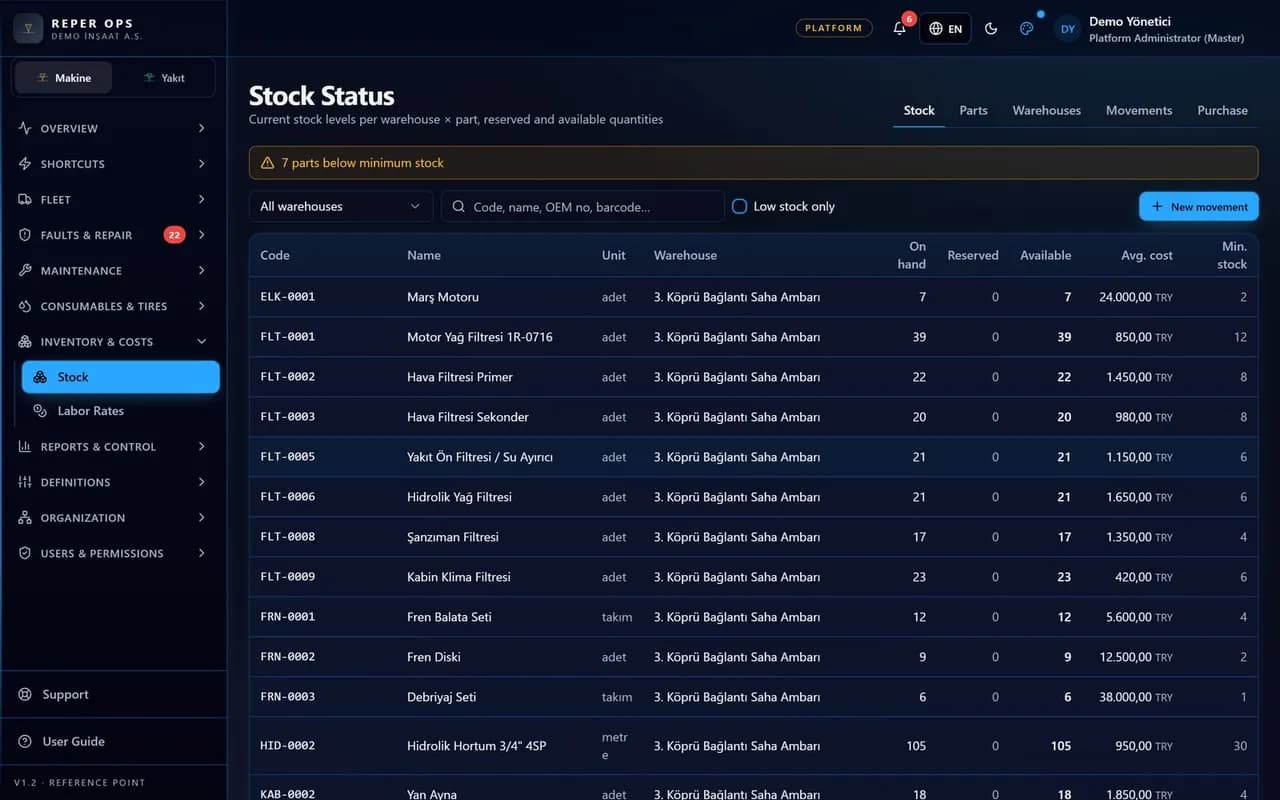
Central printing beats handwritten tags. spare parts inventory module keeps item and bin codes aligned to one template.
Receipt speed
Linear codes scan fast on flat cartons; QR can tolerate curved faces. Lighting and lens quality beat code type for phone vs industrial guns.
Define manual lookup when a scan fails; quarantine unlabelled goods before posting receipt.
- Contrast test labels.
- UV stock for outdoor bins.
- Do not print both symbologies.
- Review failed scan rates weekly.
Counts and transfers
In blind count, the code only identifies the SKU. QR deep links must not open the wrong screen in the field app.
Transfer lists must match scanned items or you split stock across two records.
Devices
Phones are a cheap start; industrial readers win under dust and vibration. One device standard lowers training cost.
Test offline queues if connectivity is weak.
Label lifecycle
Replace worn labels during count week or ghost stock appears.
warehouse and inventory management prints from the item master so code and card stay matched.
Decision
Short SKU, indoor bins: barcode often enough. Rich payload: QR. Measure scan success, not theoretical capacity.
Send label spec to suppliers and reject non-compliant tags at receipt.
Managing the transition period
For “Managing the transition period” (label), step 1: mirror the Turkish control on site—roles, records and approvals must stay explicit.
For “Managing the transition period” (label), step 2: mirror the Turkish control on site—roles, records and approvals must stay explicit.
Performance measurement
For “Performance measurement” (label), step 1: mirror the Turkish control on site—roles, records and approvals must stay explicit.
For “Performance measurement” (label), step 2: mirror the Turkish control on site—roles, records and approvals must stay explicit.
Roles and daily rhythm
For “Roles and daily rhythm” (label), step 1: mirror the Turkish control on site—roles, records and approvals must stay explicit.
For “Roles and daily rhythm” (label), step 2: mirror the Turkish control on site—roles, records and approvals must stay explicit.
For “Roles and daily rhythm” (label), step 3: mirror the Turkish control on site—roles, records and approvals must stay explicit.
Audit preparation
For “Audit preparation” (label), step 1: mirror the Turkish control on site—roles, records and approvals must stay explicit.
For “Audit preparation” (label), step 2: mirror the Turkish control on site—roles, records and approvals must stay explicit.
Closing notes
For “Closing notes” (label), step 1: mirror the Turkish control on site—roles, records and approvals must stay explicit.
For “Closing notes” (label), step 2: mirror the Turkish control on site—roles, records and approvals must stay explicit.
For “Closing notes” (label), step 3: mirror the Turkish control on site—roles, records and approvals must stay explicit.
Additional practical notes
For “Additional practical notes” (label), step 1: mirror the Turkish control on site—roles, records and approvals must stay explicit.
For “Additional practical notes” (label), step 2: mirror the Turkish control on site—roles, records and approvals must stay explicit.
For “Additional practical notes” (label), step 3: mirror the Turkish control on site—roles, records and approvals must stay explicit.