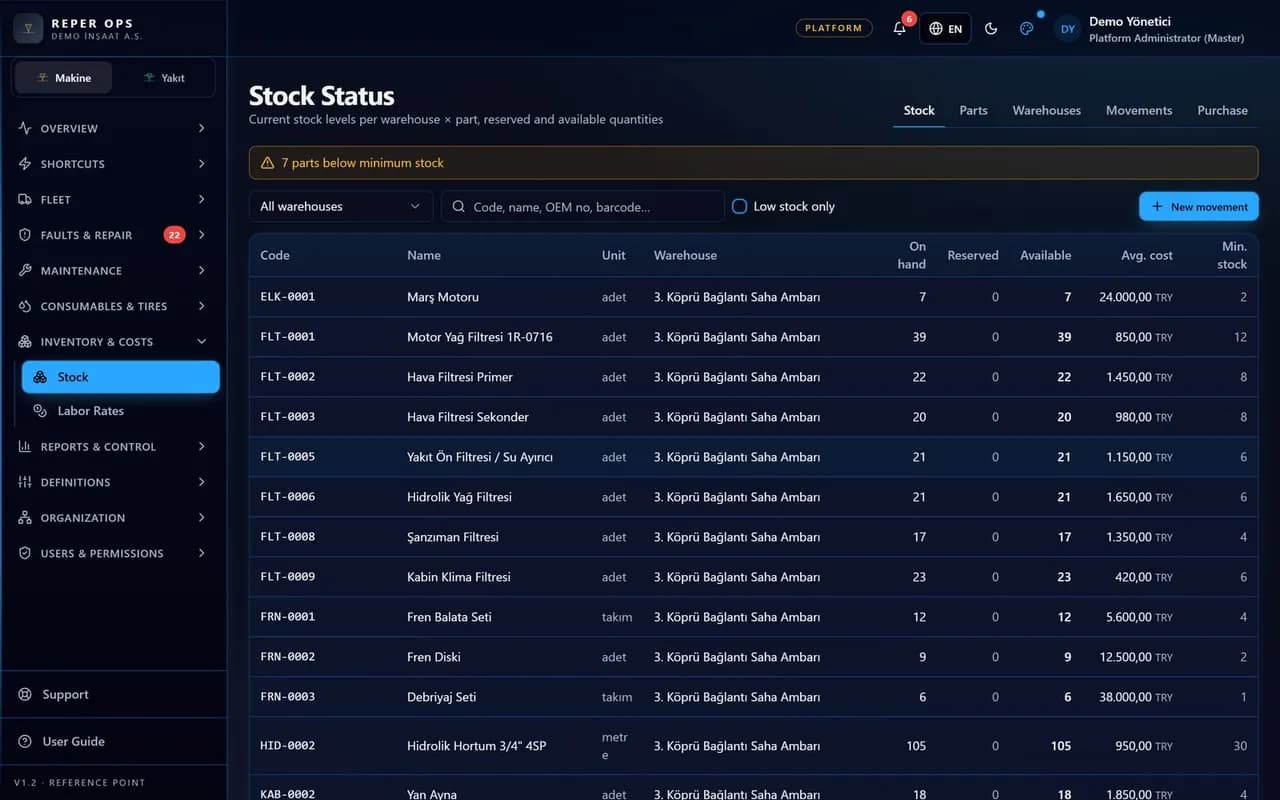
What ROP measures
Reorder point is the level that should trigger a new order before stockout. It is meaningless without lead-time consumption.
Site usage is spiky; one month's average misleads. Mass uses ninety-day OUT movements for daily usage.
Lead time sources
Lead time days come from supplier-material, else part card, else default seven. Wrong lead time skews ROP.
For imports include customs and haul; for local suppliers add approval days. Review lead times periodically.
Safety stock and three-day rule
Safety stock buffers delay and variability. Default ROP uses usage×lead plus three safety days unless reorder point on the part card is set.
Raise safety days for critical breakdown parts; low safety with larger order qty may suit consumable fasteners.
Coverage days and suggested qty
Coverage days target how many days of stock you want. Suggested qty uses max(reorderQty, usage×(lead+horizon) − available).
Available is on-hand minus reserved; quarantine and consignment are separate. Negative stock needs count or adjustment before trusting suggestions.
Open PO netting
Reason COVERED_BY_ORDER nets open PO quantity against need; includeCovered shows those lines.
Partial shipments count only un-received quantity toward open PO netting after the goods receipt is saved and approveds.
ROP parts without stock rows
below-reorder list includes ROP parts without stock rows using default GENERAL warehouse—common right after cutover.
Creating draft orders
draft order creation builds draft purchase orders per supplier and warehouse—you approve before send.
Order Suggestions page under Procurement; report and dashboard card read the same engine.
Think with ABC cycle count
ROP alerts lie when ledger is wrong. Cycle count hits A items more often—count before trusting ROP on long-skipped SKUs.
spare parts inventory module movement discipline feeds warehouse and inventory management replenishment—unlogged issues won't drop ROP.
Roles and replenishment meeting
Weekly replenishment review with procurement prioritises BELOW_REORDER and maps COVERED_BY_ORDER to PO schedules.
Workshop leads propose manual reorderPoint when ninety-day OUT is not representative.
Finance compares draft PO totals to project budget; DRAFT is not send approval.
Clear negative stock before replenishment or suggestions inflate.
Additional practical notes
supplier-material record lead time overrides part default; update on vendor change.
reorderQty is minimum order batch; suggestions never fall below it.
includeCovered shows PO-netted lines; hiding them increases stockout risk.
ROP parts without stock rows appear under GENERAL—first checklist after cutover.
Delayed ABC-A counts undermine ROP—schedule count first.
Dashboard card and Order Suggestions page share data; mismatches mean filter or warehouse scope differs.
Draft POs come from draft order creation; no auto-send email.
Coverage days vary by project intensity; one global value rarely fits all sites.
Audit readiness
Pair replenishment report with open draft purchase order list; map COVERED_BY_ORDER lines to PO due dates.
Manual reorderPoint changes need reasons in the change log for audit comparison to the formula.
New cards without ninety-day OUT delay first alerts—set minimum reorderPoint during cutover.
Raise the default three safety days for distant suppliers; supplier-material record lead time should support it.
If dashboard and report differ same day, check warehouse filter and includeCovered.
Sustainable improvement cycle
At month-end, review replenishment, invoice match, lot expiry and kit/consignment reconciliation together—if one module KPI breaks another, root cause is joint. Mass feeds this from one movement ledger.
Name approvers for each exception type: variance invoice notes, quarantine lot release, kit assembly shortages, consignment period invoices. Track exception rate monthly.
Negative stock, unmatched invoice lines and EXPIRED lots clustering on one warehouse code in the same week triggers bin or unit review before blaming software.
External audit pack: saved count session summary, matched/variance mix, FEFO strict violation sample, kit cost tie-out, consignment consigned quantity closure—PDFs linked to supplier invoice record and receipt lines.
Onboard staff with fifteen-minute demos of import templates, Order Suggestions page filters, invoice wizard and lot labels; supervised first week instead of certificate-only training.
At project close, clear draft purchase order, unmatched invoices, QUARANTINE lots and open consignment usage record before team disperses—checklist mirrors Mass onboarding card on the dashboard.
Operational decisions rely on one ledger—replenishment, invoice tolerance, FEFO and kit assembly readiness no longer use side spreadsheets.
Each KPI owner commits one improvement next month; if missed, fix the process not the target.
Flows match shipped Reper Mass behaviour; (count lot picker, digest language) reflect the current release.