
Tire Management Software: Fitting, Tread Depth and Life Tracking
Track the life of every single tire
An axle and position layout is defined per vehicle; tires are held in stock by serial number, fitted, removed and rotated. Tread depth measurements and events such as punctures, cuts, retreading and scrapping are gathered in the same history. Life and cost are compared by brand and by size.

Configuration templates
The axle and position layout arrives ready per machine group. Fittings recorded against the wrong position become rare.

Viewed on site with a QR code
Scanning the machine's QR code shows the tire configuration, the fitting status and the last tread depth. The field team learns the tire's condition standing next to the machine.

Tread depth trend
The slope of successive measurements shows when a tire will run out. The changeover downtime goes into the plan ahead of time.

Fitting and removal history
Which tire ran on which vehicle and for how long is tracked by serial number. A removed tire returns to stock with its remaining life.

Event log
Punctures, cuts, retreading and scrapping are kept in one history. Problems that repeat in the same position become visible.
Brand and size comparison
The tire report compares life against cost by brand, size and vehicle. The purchasing decision rests on real performance in the field.
How it works
- 1
Define the layout
Set up the axle and position configuration per machine group.
- 2
Stock and fit
Tires are recorded by serial number and fitted to a position.
- 3
Measure and record
Tread depth measurements and events are logged on a regular basis.
- 4
Make the decision
Replacement or retreading is planned from the trend and cost report.
Setting up layouts and stock in tire management software
First the relevant group is opened from the Machine Groups page and axles are added in the Tire Configuration section, with the number of positions set for each axle. No tire can be fitted to a machine without a defined layout; once the layout is saved, every machine in the group uses the same axle and position arrangement. Tires are taken into inventory by serial number, with the brand, size and initial tread depth recorded.
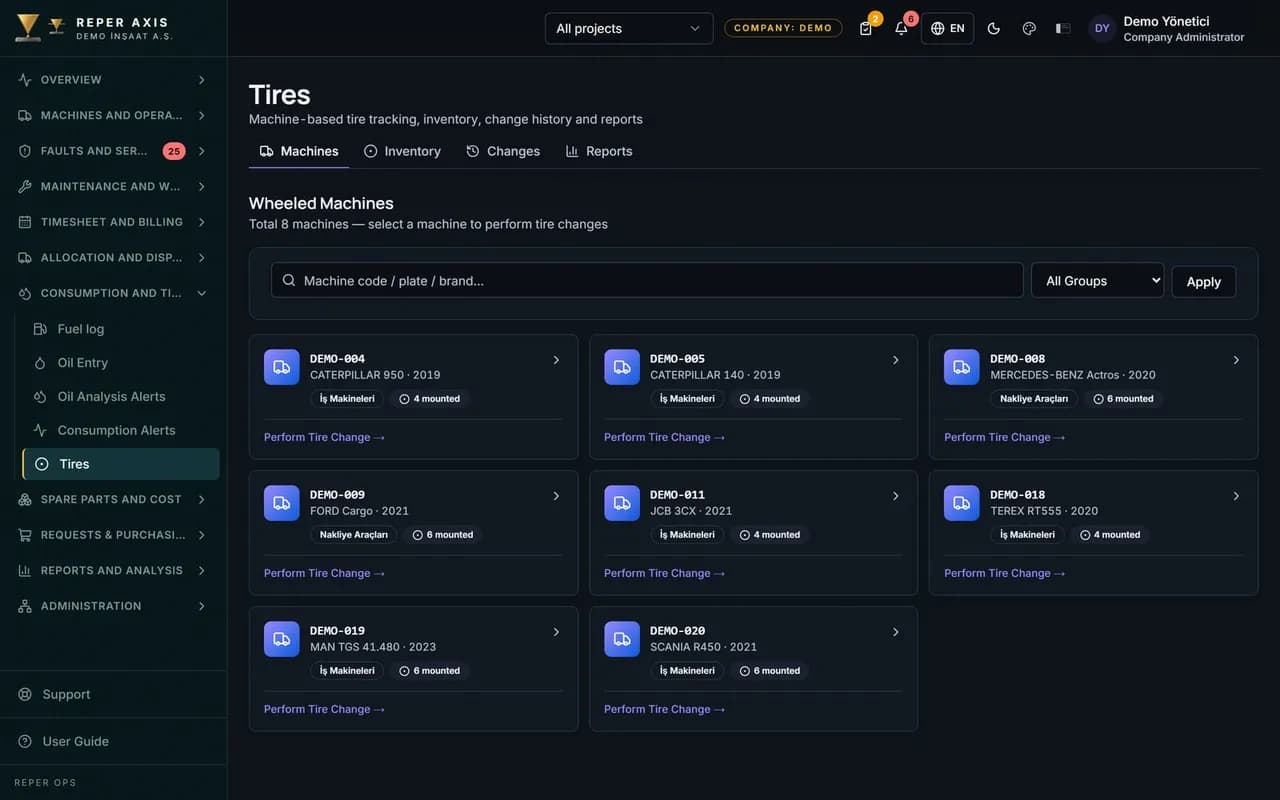
Under Tires in the Consumables and Tires menu there are Machines, Inventory, Changes and Reports pages. The Inventory page shows tires in the warehouse and tires on machines together.
Fitting, removal and measurement
On the Machines page under Tires, the machine is selected, an empty position on the axle layout is clicked, the tire to be fitted is chosen from inventory or a new tire record is created, and the fitting date and meter reading are entered. To remove one, an occupied position is clicked, the Remove action is selected and a reason is given: wear, damage or rotation. The tire returns to inventory with its remaining life and last measurement, or is set aside for scrapping; a new tire can be fitted to the same position. Tread depth measurements and events such as punctures, cuts and retreading are written to the same history. Scanning the machine's QR code in the field shows the tire configuration, the fitting status and the last tread depth.
The reports the manager sees
The Changes page lists past fitting and removal movements with the machine, position and date. Tire life is calculated from the difference between the meter readings at fitting and removal; total life is the sum of all service periods, so the history of a tire moved to another machine is never broken. The Reports page puts life and cost side by side by brand, size and vehicle; the slope of successive tread depth measurements shows when a tire will run out and lets the changeover downtime enter the plan ahead of time. Damage that repeats in the same position points to an axle or usage problem. Tables are exported as Excel and PDF.
How it connects to the other modules and who it is for
Tire life rests on the meter module; on a machine where the meter is not entered regularly, the life calculation becomes misleading. A tire change can be added to a maintenance work order as a task, and the tire cost appears in the machine cost report. It suits companies running truck fleets and wheeled heavy equipment such as loaders and graders, who see tires as one of their largest consumable items and want to base brand selection on real performance in the field.
FAQ
What happens to a removed tire
With the removal record it returns to stock with its remaining life and its last measurement. It can be refitted to a suitable vehicle, or sent for retreading or scrapping.
Can I see which brand lasts longer
Yes, the tire report compares life against cost by brand, size and vehicle. The performance of different brands on the same site is read side by side.


Ready to digitize your equipment fleet?
Take the first step toward a more efficient, more controlled and more profitable operation.