
Why tire tracking is a discipline of its own
In most fleets heavy equipment tire tracking ends at the purchase invoice: a tire is bought, fitted, and replaced when it is finished. Yet tires are one of the largest consumable items outside maintenance.
The core idea is to treat a tire as an asset with its own identity rather than a part of the machine. Every serialised tire enters stock, is fitted to a position, is measured, removed, refitted elsewhere, retreaded and finally scrapped.
This guide covers building position based tracking, turning tread depth readings into decisions, and reading tire cost.
Position based tracking: axle and position layout
Tracking starts by defining the axle and position layout for each vehicle type. A wheel loader has four positions; a dump truck has a steer axle, dual rear axles and a spare. Without the layout you cannot know where a tire sits.
Templating the layout by machine group makes fitting records easier. Every truck of the same model uses one layout, so a new vehicle inherits it and wrong position entries fall away.
Position is also the key to wear analysis. Early wear or damage that repeats in the same position may come from the axle, the alignment, the loading pattern or the ground, not from the tire.
Tread depth measurement and reading the trend
Tread depth is the most direct indicator of remaining life. It is taken in millimetres with a depth gauge at several points and recorded with the date and the current meter reading.
A single reading only describes that day. The value lies in the slope of consecutive readings: knowing how many millimetres wear away over how many working hours predicts when the tire reaches its limit, so the change can join a planned stop.
Frequency depends on machine type and how abrasive the site is. Regularity is what counts, and measuring next to the machine with the record filed immediately removes the risk of a paper form being forgotten.
- Record date, meter reading and position with every measurement, or wear rate cannot be calculated.
- A clear difference between the two sides of an axle can signal a mechanical problem.
- Plan parts and labour ahead for tires approaching the replacement limit.
Rotation, replacement and event records
A tire lives through many events and each is worth recording. Rotation moves it to another position on the same vehicle to even out wear. Replacement removes it and fits another in its place. Punctures, cuts and sidewall damage are early losses.
Retreading gives a new tread to a tire whose casing is sound and saves real money in the right conditions. A tire sent for retreading leaves stock and returns as a retreaded tire, with the retread cost added to its total.
The value of event records is that they expose patterns. Cuts concentrated on one site point to ground housekeeping; early sidewall damage on one brand points to product choice.
- A rotation record holds the old position, the new position and the meter reading.
- On replacement the removed tire's final tread depth is measured and recorded; it drives the return to stock decision.
- Punctures and cuts carry a cause field so ground, loading, pressure or product can be analysed later.
- Retread despatch and return dates and the retread fee accumulate on the tire's own record.
Cost per tire and life calculation
Cost per tire is everything spent on it: purchase price, fitting and removal labour, repairs and retreading. Life is the total working hours or kilometres accumulated while fitted, summed across every vehicle it served.
In plain words: tire cost per hour equals total tire cost divided by total working hours. Averaged by brand, size and vehicle type this gives a genuine purchasing comparison; a cheap tire with a short life can be expensive per hour.
A removed tire must return to stock with its remaining life. One with adequate tread can go onto another vehicle instead of triggering a purchase, and keeping its last measurement and history makes that decision quick.
How Reper Axis does this
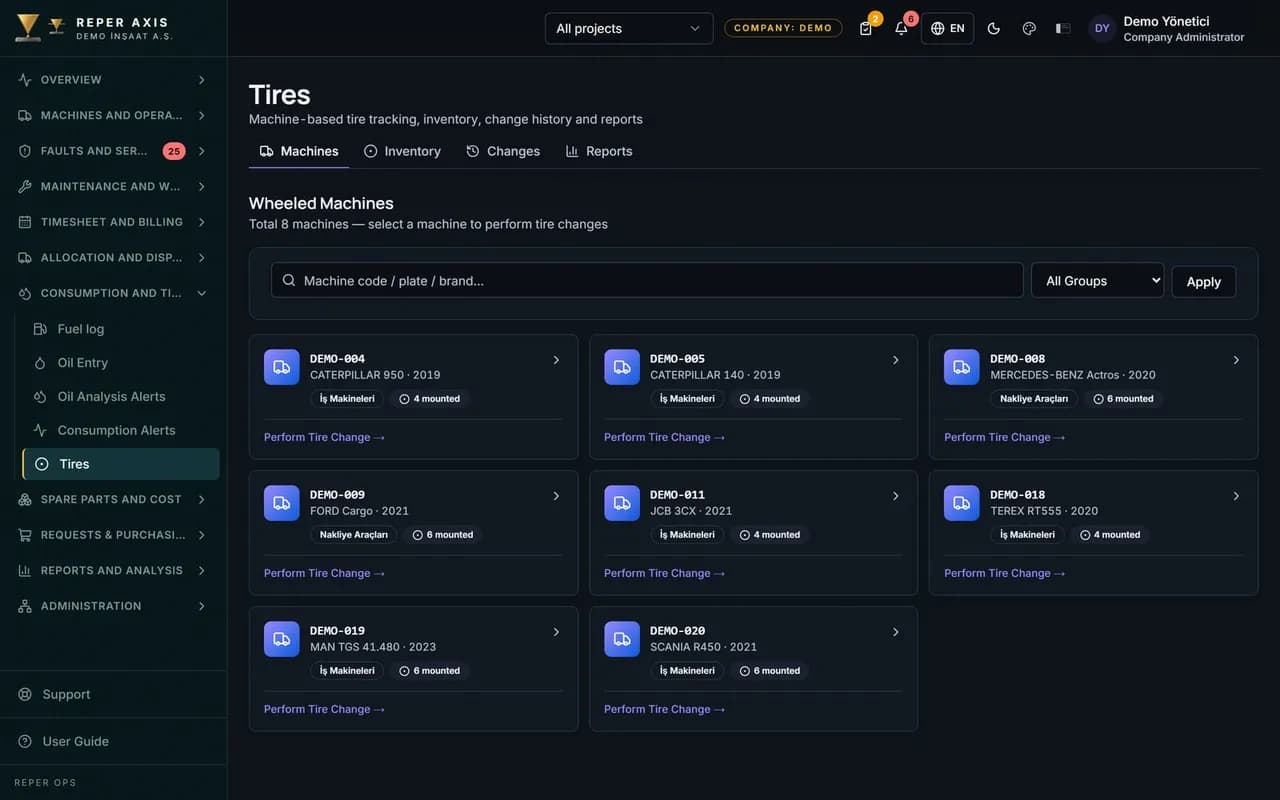
In the Reper Axis tire module an axle and position layout is defined per vehicle, with ready templates by machine group. Tires are stocked by serial number, fitted, removed and rotated. Tread readings sit alongside puncture, cut, retread and scrap events in one history.
Scanning the machine QR code in the field shows the layout, fitting status and last tread depth; with no connection the record queues on the device and is sent later. A removed tire returns to stock with its remaining life, and the tire report compares life and cost by brand, size and vehicle, exporting to Excel or PDF.