
The contract assigns responsibility; the records prove it
On a rented machine, maintenance responsibility is set by the rental contract. Where the contract is silent, the parties look at their records. This guide is not legal advice. It lists the questions to ask when you draft a contract or before you go into a billing meeting, and the records that will answer them.
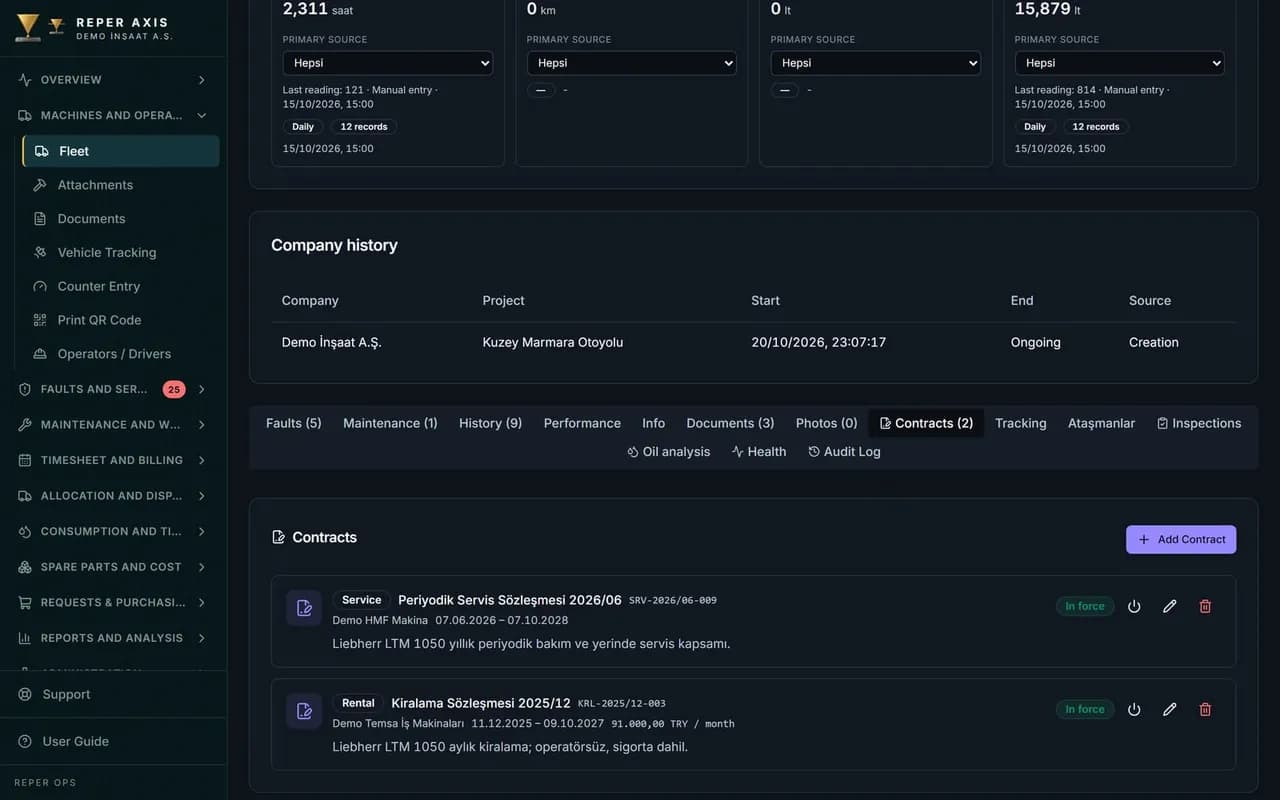
The industry often speaks of dry hire and wet hire. In dry hire the machine is usually handed over without an operator and without fuel, and the hirer provides both. In wet hire the operator and the fuel come from the hire company. The split of maintenance can differ in either case, so read the clause and not the name. In the contract record on the machine card, the options operator included in rent and fuel included in rent record this difference.
The usual split, item by item
The split below is a common starting point, not a rule. The question at the end of each line shows what the contract must answer clearly.
- Scheduled maintenance and consumables (oil, filters): usually the hire company. At what hour interval, by whom, and with which parts?
- Fuel and grease: the hirer in dry hire. Is the daily greasing of grease points the operator's job or the hire company's?
- Wearing parts (bucket teeth, tracks, cutting edges): usually the hirer. If the wear limit is not written as a measurement, there will be a dispute.
- Repair of a fault under normal use: usually the hire company. Are the response time and the replacement machine time written in hours or days?
- Damage caused by operator error: usually the hirer. Is it the responsibility of whoever employs the operator, or of the party using the machine?
- Accident: according to fault. Who determines the fault and with which document, and who bears the insurance excess?
Eight questions the contract should answer
Before you sign a rental contract, ask the questions below in order. Every question left unclear turns into a billing dispute at the end of the month.
- At which meter value is scheduled maintenance done, and is the maintenance day deducted from the rental period?
- Through which channel, to whom and by what time must a fault be reported for downtime to start counting?
- Is downtime counted by the hour or by the full day? What is the rule for a machine that worked half a day?
- Is there a limit on repair time and an obligation to supply a replacement machine?
- By what measurement is the wearing-part limit set?
- Who separates operator error from a manufacturing defect, and with which record?
- In an accident, does the rental period stop, and how is fault determined?
- How is the check made on return, and how many days are allowed for objections?
Rent deduction after a fault: a worked example
An example: the daily rate is €500. The machine fails on the morning of the 12th day of the month and the fault record is opened at 08:00 that day. The repair is finished at 17:00 on the 15th, and the machine worked half of that day. If the contract counts full days, the 12th, 13th and 14th are deducted: 3 × €500 = €1,500. If the contract has no half-day rule for the 15th, each side calculates differently and the dispute gathers on that day.
On the record side, the chain is built like this. When the question can the machine operate is answered no in the fault record, a downtime opens automatically. When the work is finished, the machine is working again marker closes the downtime. In the Machine Timesheet module, the faulty and in maintenance statuses come by default with the deduct from rent marker. A partly worked day is billed. At contract level there is also an option, deduct downtime days from rent. In a contract where it is left off, downtime does not create a deduction. The system works on a daily basis. Special conditions such as an hourly tolerance stay in the contract text, and the difference is written in the note for that day. How the deduction reaches the amount is explained step by step in the rented equipment billing guide.
Evidence at hand-over and return
The question of damage or wear is answered on the day of return, and the answer rests on the record from the day of hand-over. At hand-over, four things go on the machine card: the meter value, photographs from every side, the measurements of wearing parts such as bucket teeth or tracks, and the attached contract file.
The photographs tab of the machine holds the images, and the contracts tab keeps the contract with the machine through its file field. For a wearing part the rule is simple. If a tooth measured 62 mm at hand-over comes back below the limit in the contract, the wear dispute is settled by the measurement. If there is no measurement, you are left with the photographs and the meter difference. The planned and actual return date fields close the rental period. Once a return date is entered, the time after it does not enter the rental period.
- At hand-over: meter, photographs, wearing-part measurements, a list of existing damage.
- During use: every fault is recorded with a photograph and the meter value.
- At return: the same photograph angles, the meter and the measurements. If there is a difference, a written objection on the same day.
If the hire company does the maintenance, keep the record yourself
Even when maintenance is the hire company's duty, you should hold the record that shows it was done on time. A maintenance programme is assigned to a rented machine as well. The meter value is the trigger, and upcoming and overdue items appear on the maintenance panel. When the hire company's service engineer visits, the job is recorded as external service.
This record helps in a dispute. For example, an oil change was due at 500 hours, the hire company's service came at 540 hours, and the engine failed 20 hours later. The meter history and the delay on the maintenance panel show that maintenance was 40 hours late, in a way both sides can see. Without a record, you are left with memory.
Taking one page to the monthly meeting with the hire company
The month-end billing meeting is short if the records were gathered beforehand. For each rented machine, prepare the five headings below. Each can be taken from the machine card or from the fault and maintenance lists. The same page is also your first answer to any objection about deductions from the hire company.
An example: three rented machines, one month. One has two fault days, one has an overdue oil service, and one has an accident record. If the page has one row per machine, and each row has the date, the meter value and the related record number, the discussion runs on record numbers and not on recollection.
- Open and closed faults: time reported, whether the machine could operate, time closed.
- Maintenance status: the meter value at the last service, and any overdue or approaching item on the maintenance panel.
- Downtime days: the number of faulty, in maintenance and accident days in the timesheet.
- Meter difference: the hours on the hire company's invoice against the total of the meter records.
- Open objections: which day, and under which record it is disputed.
Accident and fault records
In an accident record, the fault field and the deduct from rental billing marker are separate. The record shows which party is held responsible, and your contract decides on the deduction. Expert reports, official statements and photographs are attached to the accident record. An accident day is a separate status in the timesheet, and it enters the deduction only if deduct from rental billing is ticked on the accident. The fault record opened for the repair after an accident carries the actual labour and parts cost separately.