
What MTBF and MTTR mean and why they pair
Any manager who wants to discuss maintenance performance in numbers meets MTBF and MTTR. Both come from reliability engineering, and read together they describe how often a machine stops and how quickly it returns to work.
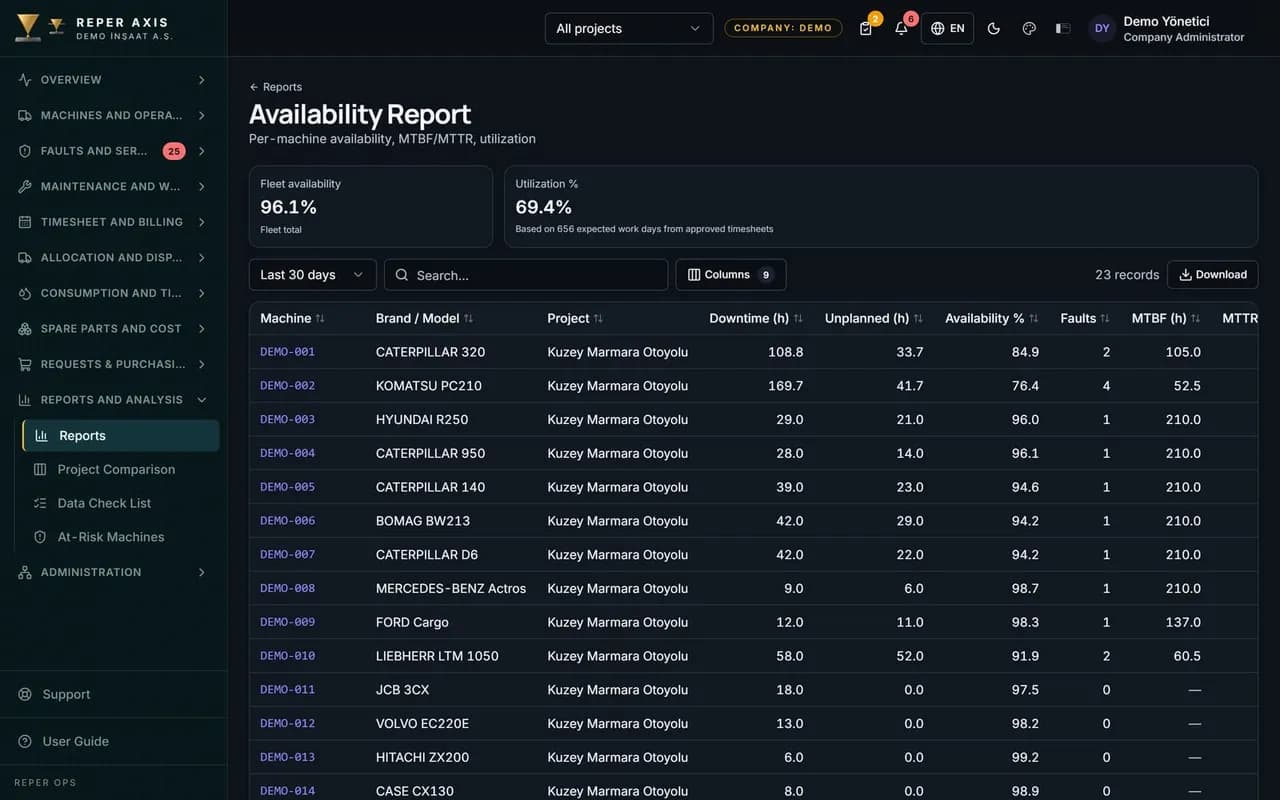
MTBF is mean time between failures and shows how reliably a machine runs. MTTR is mean time to repair and shows how fast the maintenance organisation responds. Availability is the outcome of the two.
Neither is enough alone. High MTBF with a long MTTR means rare but lengthy stops; low MTBF with a short MTTR means frequent but brief ones. Together they tell you where to invest.
Definitions and formulas
The formulas are deliberately plain; what matters is applying the same definition consistently across the fleet.
MTBF equals total operating time in the period divided by the number of failures in that period. Operating time is either actual working hours or planned time minus downtime, and the result is in hours.
MTTR equals total repair downtime divided by the number of failures. Repair time runs from the moment a fault is reported to the moment the machine can work again, including waits for parts and service, because the machine is idle then too.
Availability equals planned operating time minus total downtime, divided by planned operating time, times one hundred. Planned operating time is the shift length the company schedules; ten planned hours a day means the calculation uses those ten hours.
Why the downtime record decides everything
Downtime is the shared input of all three measures. Record it badly and MTTR looks short, availability looks high and MTBF looks optimistic; the report reads well but no longer describes the site.
The most common loss is writing start and end times from memory afterwards. If the reporting and closing moments are stored in the system, downtime is derived automatically. Machines in the workshop or in transit between sites are also down.
The second loss is counting faults that leave the machine operable as downtime. Whether the machine can still work should be a separate field on the fault record, and only non operable faults should start the clock.
Separating planned and unplanned downtime
Not all downtime is the same. Time set aside for planned maintenance is known in advance, written into the schedule and managed without surprise. Unplanned downtime comes from failures and creates the real loss.
MTBF and MTTR are calculated on unplanned downtime only. Availability can be reported two ways: total availability includes every stop, operational availability only the unplanned ones. State clearly in the report which one you used.
Recording the reason as fault, maintenance or transfer makes that distinction possible. A downtime total without reasons can suggest, wrongly, that increasing planned maintenance has damaged availability.
In a well run fleet the expected trend is that unplanned downtime falls while planned downtime grows in relative terms. Even at constant total downtime, that shift means the loss has become predictable.
How to set target values
There is no universal MTBF or availability target; the figure depends on machine type, age, operating conditions and sector. Starting from your own data is healthier than borrowing numbers from outside.
The practical method: collect at least three to six months of clean downtime data, calculate current values by machine group, then set a target that improves each group step by step. Approaching the best machine in the group is a concrete reference.
Separate targets by measure. MTBF reflects the maintenance programme and part quality; MTTR reflects workshop capacity, part availability and service response. Improving both at once is hard, and the data tells you which loss is larger.
How to read an availability report
Read the machine and group breakdown before the fleet total. A healthy average can hide a handful of machines that stop constantly, and the list of worst offenders shows where to start.
Then look at the downtime reason mix. Heavy fault downtime points to the maintenance programme and operator practice; heavy maintenance downtime to planning and workshop time; heavy transfer downtime to site logistics.
Finally go into the MTTR components. If most repair time is spent waiting for parts, the problem is stock policy, not the workshop. Repeated faults in the same category on one machine mean the repair happens but the root cause survives.
How Reper Axis does this
Reper Axis does not ask you to track downtime by hand. Opening a fault marked as non operable starts the downtime record and closing it ends the record; maintenance work orders and site transfers are logged the same way. Planned daily hours are defined per company, machine group or single machine.
MTBF and MTTR are reported per machine and for the fleet, the worst stopping machines head the dashboard list, and twelve months of downtime appear in a chart broken down by reason. An authorised user can correct a record, and the change is written to the audit trail.